


Responsibility and accountability have always been at the core of what we do at the Shipowners’ Club. Our Corporate Responsibility (CR) strategy is the way in which we seek to identify and address the issues and opportunities we encounter, with the aim of having a more positive impact on our staff, stakeholders, the environment and society at large.
In line with the Club’s mutual ethos, our CR work is undertaken against the backdrop of always ensuring that any related task:

is transparent to all stakeholders

is proportionate and fit for purpose and complements the Club’s business model

is of benefit/value to its Membership
Sustainability roadmap
When embarking on the Club’s sustainability roadmap, ensuring the appropriate CR Governance was in place was a priority and this has led to the establishment of robust internal systems. This included the undertaking of a Materiality Assessment to identify the Environmental, Social and Governance (ESG) issues that are most material to the Club’s long-term sustainability.
As part of the process, 16 issues were identified that were relevant and considered important to the Club as an insurer and a member of the maritime industry. These issues were prioritised by the Corporate Responsibility Advisory Committee, the Club’s internal stakeholder working group which was in place at the time, in relation to the Club’s sustainability as a business, as well as its ability to influence them.

Documents


Materiality Matrix
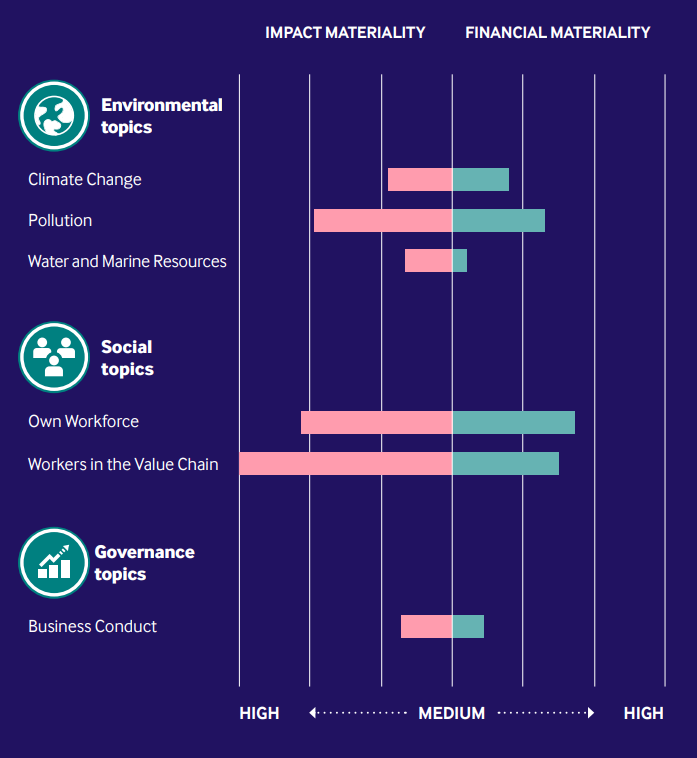
In early 2025, the Club carried out a Double Materiality Assessment (DMA) to meet CSRD requirements. This built on earlier materiality assessments completed in 2022 and 2024 whilst introducing a mandatory dual perspective that considers how external ESG factors financially impact the Club's activities and how the Club’s activities affect the environment and society. Around 100 high-impact ESG topics were reviewed, leading to the identification of six key material areas to the Club and its value chain:
- Water and Marine Resources
- Pollution
- Climate Change
- Own Workforce
- Workers in the Value Chain
- Business Conduct
The DMA results (opposite) were broadly aligned with the 2024 materiality survey, with minor differences in prioritisation due to the DMA’s longer-term outlook and its inclusion of both impact and financial materiality. The Club is utilising this data to help inform its future Corporate Responsibility strategy.
Logic Model
A key output of the Club’s CR strategy is the development of Key Performance Indicators (KPIs) that can be used to measure its CR activities and its impact on society and the environment, and identify how these change over time.
As part of this process, the required impact and outcomes were pinpointed which drove the identification of the inputs and activities required to achieve these. This process resulted in the development of the Club’s Logic Model. This in turn defined the quantitative summary of activity in the form of KPIs that covered the Club’s internal and external operations based on areas such as health and wellbeing of staff and seafarers, diversity in the workplace, productivity, stakeholder ethics and trust and satisfaction of Members.


We will strive to incorporate and embrace a CR strategy that focuses on the long-term sustainability of the Club whilst adding value to its business activities for the benefit of our Membership."
Donald A. MacLeod KC
Chairman of the Association

Campaigns


Partner of choice
The Club is committed to being the partner of choice for our stakeholders by providing a high level of service and support to them when needed. We do this by striving to achieve our Vision ‘Ensuring Peace of Mind’. Instrumental to this ambition are our partnerships with our trusted partners worldwide. Our partners are an extension of the Club and therefore it is imperative to ensure that the standards we set ourselves are reflected in the services they provide. The Club has developed its Code of Conduct to ensure our ethos and ethics, which we strive to achieve, are understood by our partners and their supply chains.


Item 1
Governance
When embarking on the Club’s sustainability roadmap, ensuring the appropriate CR Governance was in place was a priority and this has led to the establishment of robust internal systems.
A
rating
ESG impact of the Club’s investment portfolio.
Trust & Satisfaction of Members, Risk Management, Transparency & Reporting, Sustainable Operations, Decarbonisation, Health & Wellbeing of Staff and Seafarers and Equity, Diversity & Inclusion have been identified through a materiality survey as priorities for the Club and all stakeholders.
0
Number of cases reported as non-compliant with the Code of Conduct.

Item 2
Environmental
Minimising environmental impact, including decarbonisation, is a global concern. Engaging and learning from our Membership, in conjunction with industry bodies, is fundamental in ensuring we continue to offer insurance solutions and services that support our Members into the future.
2,150
tonnes CO2e
total emissions emitted by the Club’s operation in 2023.
98%
of applicable vessels whose flag state requires a Carbon Intensity Indicator (CII) rating.
Dedicated “emission reduction” platform on the Club’s website to ensure Members are kept up to date on industry measures, regulation and technological advancements.

Item 3
Social
When considering the Club’s responsibility to society, three communities have been identified, namely the Club’s employees, the seafaring community and the local community in relation to its office locations.
27.1
hours
the average time each employee spent on learning and development.
89%
employee retention rate.
6,316
downloads
of the ISWAN app since launched.
Meet the team

Charlie Weatherill
Senior Underwriter / Corporate Responsibility Executive

Daniel Fryett
Chief Actuary

Louise Hall
Director – Loss Prevention & Corporate Responsibility

Shev Algama
Europe & Africa Syndicate Manager – Claims

Sophie Lake
Marketing Executive
Read bioPartnerships
Take a look below to learn more about the partners the Club collaborates with in this area.
At the Shipowners' Club, we strive to align our strategy and operations with the Ten Principles of the United Nations Global Compact. The UN Global Compact is a voluntary initiative that covers Ten Principles related to labour standards, human rights, environmental protection, and anti-corruption.
The Club considers the health and wellbeing of seafarers to be core to achieving a safe marine operating environment. In partnership with the International Seafarers’ Welfare and Assistance Network (ISWAN), we look to raise awareness of crew health and to assist our Members in mitigating against related incidents.
The Club is committed to driving positive change in the maritime sector. Corruption in shipping often translates into hidden costs, delays, and risks for our Members. Through our membership of the Maritime Anti-Corruption Network (MACN), we contribute to initiatives that reduce these burdens, improving operational efficiency and delivering better outcomes for our Members and the global community.
At the Shipowners' Club, we strive to align our strategy and operations with the Ten Principles of the United Nations Global Compact. The UN Global Compact is a voluntary initiative that covers Ten Principles related to labour standards, human rights, environmental protection, and anti-corruption.
The Club considers the health and wellbeing of seafarers to be core to achieving a safe marine operating environment. In partnership with the International Seafarers’ Welfare and Assistance Network (ISWAN), we look to raise awareness of crew health and to assist our Members in mitigating against related incidents.
The Club is committed to driving positive change in the maritime sector. Corruption in shipping often translates into hidden costs, delays, and risks for our Members. Through our membership of the Maritime Anti-Corruption Network (MACN), we contribute to initiatives that reduce these burdens, improving operational efficiency and delivering better outcomes for our Members and the global community.